
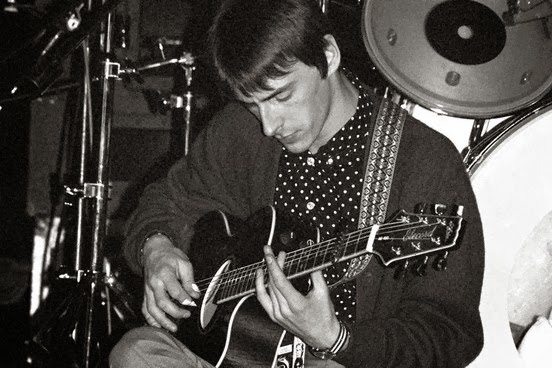
Paul Weller (nome artístico de John William Weller, nascido em 25 de maio de 1958 em Sheerwater, Surrey) é um cantor e compositor britânico. Weller foi o líder e criador por trás de duas bandas de sucesso, The Jam e The Style Council, antes de dar início a uma bem-sucedida carreira solo. Ele é também a principal figura do mod revival do final dos anos 70, sendo por essa razão apelidado de Modfather.
Uma boa biografia de Paul Weller, em inglês:
Weller was born on 25 May 1958 in Sheerwater, near Woking, England, to John and Ann Weller. He was initially known as John William Weller but later acquired the name Paul. His father worked as a taxi driver and his mother was a part-time cleaner. In 1963 Weller started his education at Maybury County First School. His love of music started with The Beatles, then The Who and the Small Faces. By the time Weller was eleven and moving up to secondary school at Sheerwater County Secondary music was the biggest part of his life and he began playing the guitar.

In 1972 Weller formed the first incarnation of The Jam, playing bass guitar with his best friends Steve Brookes (lead guitar) and Dave Waller (rhythm guitar). Weller's father, their manager, began booking the band into local working men's clubs. Joined by Rick Buckler on drums, and with Bruce Foxton soon replacing Waller on rhythm guitar, the four-piece band began to forge a local reputation playing a mixture of Beatles covers and a number of compositions written by Weller and Brookes. In 1976 Brookes left the band and Weller and Foxton decided they would swap guitar roles, with Weller now the guitarist. Although The Jam emerged at the same time as punk rock bands such as The Clash, The Damned, and Sex Pistols, The Jam better fitted the mould of the New Wave bands who came later. Also, being from just outside London rather than in it, they were never really part of the tightly-knit punk clique. Nonetheless, The Clash emerged as one of the leading early advocates of the band and were sufficiently impressed by The Jam to take them along as the support act on their White Riot tour of 1977. The Jam's first single "In the City" took them into the UK Top 40 for the first time, in May 1977. Although every subsequent single had a placing within the Top 40, it would not be until the band released "The Eton Rifles", with Weller's very political lyrics, that they broke into the Top 10, hitting the No. 3 spot in November 1979. The increasing popularity of their blend of pop melodies and Weller's barbed lyrics led, in March 1980, to their first number one single, "Going Underground". They became the only band other than the Beatles to perform two songs ("Town Called Malice" and "Precious") on one edition of Top of the Pops. The Jam even had two singles, "That's Entertainment" and "Just Who Is the 5 O'Clock Hero?", reach No. 21 and No. 8 respectively in the UK singles chart despite not even being released in that country – they got there purely on the strength of the huge number of people buying import sales of the German and Dutch single releases. The Jam still hold the record for the best-selling import-only singles in the UK charts. As the band's popularity increased, however, Weller became restless and eager to explore a more soulful, melodic style with a broader instrumentation. In 1982, Weller announced that The Jam would disband at the end of the year. The announcement came as a shock to Foxton and Buckler, who felt that the band still had many years left. Their final single, "Beat Surrender", became their fourth UK chart topper, going straight to No. 1 in its first week. Their farewell concerts at Wembley Arena were multiple sell-outs; their final concert took place at the Brighton Centre on 11 December 1982.

The Jam - All Mod Cons (1978)

All Mod Cons é o terceiro álbum de estúdio do grupo The Jam, foi lançado em 1977. Pode ser visto como um marco no movimento mod revival, uma re-leitura do mod dos anos 60 no Reino Unido, do qual o The Jam foi um dos maiores expoentes . All Mod Cons, é um álbum que marca um grande salto na maturidade nas composições do grupo. Paul Weller, autor de todas as letras, empregou um estilo de narrativa de histórias com personagens e imagens vívidas da cultura britânica, como as utilizadas por Ray Davies (The Kinks), para fazer comentários sociais mais explícitos.


.jpg)
Este último álbum foi adicionado por sugestão do Brother Old School...
____________________________________________________
At the beginning of 1983, Weller collaborated with keyboard player Mick Talbot to form a new group called The Style Council. Weller brought in Steve White to play drums, as well as singer Dee C. Lee, who had previously been a backing singer with Wham! Free of the limited musical styles he felt imposed by The Jam, under the collective of The Style Council Weller was able to experiment with a wide range of music, from pop and jazz to soul/R&B, house and folk-styled ballads. The band was at the vanguard of a jazz/pop revival that would continue with the emergence of bands like Matt Bianco, Sade, and Everything but the Girl, whose members Tracey Thorn and Ben Watt contributed vocals and guitar to the 1984 The Style Council song "Paris Match". Many of The Style Council's early singles performed well in the charts, and Weller experienced his first success in North America, when "My Ever Changing Moods" and "You're The Best Thing" entered the US Billboard Hot 100. In Australia they were far more successful than The Jam, reaching the top of the charts in 1984 with "Shout To The Top". Weller appeared on 1984's Band Aid record "Do They Know It's Christmas?" and was called upon to mime the absent Bono's lyrics on Top of the Pops. The Style Council were the second act to appear in the British half of Live Aid at Wembley Stadium in 1985. In December 1984, Weller put together his own charity ensemble, The Council Collective, to make a record, "Soul Deep", to raise money for striking miners, and the family of David Wilkie. The record featured The Style Council plus a number of other performers, notably Jimmy Ruffin and Junior Giscombe. In spite of the song's political content, it still picked up BBC Radio 1 airplay and was performed on Top of the Pops, which led to the incongruous sight of lyrics such as "We can't afford to let the government win / It means death to the trade unions" being mimed amid the show's flashing lights and party atmosphere. As the 1980s wore on, The Style Council's popularity in the UK began to slide, with the band achieving only one top ten single after 1985. The Style Council's death knell was sounded in 1989 when their record company refused to release their fifth and final studio album, the house-influenced Modernism: A New Decade. With the rejection of this effort, Weller announced The Style Council had split, and although the final album did have a limited vinyl run, it was not until the 1998 retrospective CD box set The Complete Adventures of The Style Council that the album was widely available.

Weller's stated influences range widely, including The Beatles, Dr Feelgood, The Kinks, The Who, Small Faces and 1960s and 1970s soul music. He is referenced in a 1984 performance on the BBC show Top of the Pops, by the downhearted hippie Neil Wheedon Watkins Pye (played by Nigel Planer) from the sitcom, The Young Ones, in his cover of the Traffic classic, "Hole in My Shoe" in which he directly asked Paul Weller to "listen to the lyrics!". During the Britpop explosion in the mid-1990s a number of bands, such as Oasis, Ocean Colour Scene and Blur cited Weller and The Jam as a major influence. More recent generations of bands have also noted Weller as an inspiration, including Hard-Fi, Arctic Monkeys, The Enemy, The Rifles and The Moons. David Lines' memoir, The Modfather, documented his life growing up in Garforth, Leeds, and his adolescent obsession with Paul Weller. Weller was listed as one of the fifty best-dressed over 50s by the Guardian in March 2013.

Some albuns:


Esta é uma coletânea excelente, realizada por Birds With Broken Wings (Miles). Thanks Miles.


