O músico britânico Keith Emerson, conhecido por ser um dos pioneiros do sintetizador na música rock, morreu em Los Angeles aos 71 anos, informaram os seus companheiros da banda Emerson, Lake and Palmer. Keith Emerson foi encontrado com uma bala na cabeça na sua casa em Los Angeles, informou a polícia, que recebeu o alerta pela namorada do músico, Mari Kawaguchi. A morte do músico é objeto de uma investigação "por suicídio", disse a porta-voz da polícia de Santa Monica, Erika Aklufi.
"Keith era uma boa alma, cujo amor pela música e paixão pelo teclado permanecerá inigualável nos próximos anos", disse Carl Palmer, ex-baterista do grupo, em comunicado. "Ele foi um pioneiro e inovador, cujo génio musical tocou a todos no mundo do rock, música clássica e jazz", acrescentou.
Mais um grande músico que se vai prematuramente. Keith Emerson é e foi um dos meus tecladistas favoritos... Desde o Nice até seus últimos álbuns solos, este cara era impecável. Segue uma lista de Posts aqui no Valvulado...
Elmer "Lee" Fields is an American soul artist born in 1951 in North Carolina, sometimes nicknamed "Little JB" for his physical and vocal resemblance with James Brown. During his prolific 43-year career he has toured with such figures of soul and R&B as Kool and the Gang, Hip Huggers, O.V. Wright, Darrell Banks, and Little Royal. He recorded his first single in 1969 and is still active today. More recently, he made recordings with The Expressions, including the album Faithful Man (2012). In 2006, he recorded the song "Jealousy" with Martin Solveig, and in 2008, the pair recorded "I Want You". In 2014, Fields provided additional vocals for the James Brown biographical movie, Get On Up.
Lee Fields spent most of the '90s on the Ace label, recording soul-blues albums whose funkiness was often dampened by cheap-sounding, partly synthesized backing tracks. Judging by his performance on his Desco Records debut full-length Let's Get a Groove On, Fields' move to the pioneering old-school funk-revival label freed him to do the kind of gritty, authentic funk album he'd been itching to record for quite some time. Laying out his principle of "rough...nasty...genuine" funk in a spoken intro, Fields positively smokes through the whole record, capturing all the fire of late-'60s James Brown (whom he strongly and unashamedly resembles, vocally) with the help of the Desco house band, the Soul Providers, who lay down a richly organic set of guitar-and-organ-dominated funk backings. Let's Get a Groove On is blatantly derivative of its influences, but the simple act of returning wholeheartedly to those influences -- in a musical climate which has assimilated and moved away from them -- could in itself be considered an innovation. Regardless, it's a stunning performance from Fields and the record that fulfills Desco's promise -- quite possibly one of 1999's best, and definitely one of its most overlooked.
Juvenal de Holanda Vasconcelos, conhecido como Naná Vasconcelos, (Recife, 2 de agosto de 1944) é um músico brasileiro. Eleito oito vezes o melhor percussionista do mundo pela revista americana Down Beat e ganhador de oito prêmios Grammy, é considerado uma autoridade mundial em percussão. Desde jovem se envolveu os tambores nos movimentos de maracatu locais. Começou a tocar aos 12 anos com seu pai numa banda marcial no Recife. Durante toda sua carreira sempre teve preferência por instrumentos de percussão e nos anos 60 se notabilizou por seu talento com o berimbau. Em 1967 mudou-se para o Rio de Janeiro onde gravou dois LPs com Milton Nascimento. No ano seguinte, junto com Geraldo Azevedo, viajou para São Paulo para participar do Quarteto Livre, que acompanhou Geraldo Vandré no III Festival Internacional da Canção. Além disso, Naná tem uma extensa carreira no exterior.
A partir de 1967 ele atua como percussionista ao lado de diversos nomes de peso: Jon Hassel, Egberto Gismonti, Pat Metheny, Evelyn Glennie e Jan Garbarek. Formou entre os anos de 1978 e 1982, ao lado de Don Cherry e Collin Walcott o grupo de jazz Codona, com o qual lançou 3 álbuns. Em 1981, tocou no Woodstock Jazz Festival, em comemoração ao décimo aniversário do Creative Music Studio. Em 1998, Vasconcelos contribuiu com a música "Luz de Candeeiro" para o álbum "Onda Sonora: Red Hot + Lisbon", compilação beneficente em prol do combate à AIDS, produzida pela Red Hot Organization. Naná Vasconcelos ganhou, por sete anos consecutivos (1984-1990), o prêmio de Melhor Percussionista do Ano da conceituada revista Down Beat. No dia 9 de dezembro de 2015, Naná Vasconcelos recebeu o título de Doutor Honoris Causa pela Universidade Federal Rural de Pernambuco (UFRPE).
Foi com muita tristeza que recebi um email hoje do Portuga dizendo que Nana estava mal e estava precisando de uns pensamentos positivos...
"O músico Naná Vasconcelos, de 71 anos, recebeu alta da Unidade de Terapia Intensiva (UTI) no final da manhã desta segunda-feira (7). O percussionista foi transferido para um quarto no 10º andar do Hospital Unimed III, no Recife, onde estava internado na UTI desde o sábado (5) por complicações de um câncer de pulmão descoberto no ano passado. De acordo com boletim médico divulgado no início da noite desta segunda (7), o estado de saúde de Naná Vasconcelos "permanece grave, porém é estável". O músico, que está hospitalizado desde 29 de fevereiro, devido a complicações da progressão do seu câncer de pulmão, apresenta infecção respiratória e arritmia cardíaca, além de uma progressão do tumor. A família de Naná pediu para amigos e fãs realizarem uma corrente de orações pela recuperação dele. Segundo a esposa do músico, Patrícia Vasconcelos, no ano passado o artista passou mais de 20 dias no mesmo hospital, após descobrir a doença. No dia 28 de fevereiro deste ano, o percussionista passou mal após um show realizado em Salvador, na Bahia, com o violoncelista Lui Coimbra. Ao retornar ao Recife, foi internado.
Caros amigos, pedimos um pensamento positivo para que este monstro da música brasileira e internacional, este gênio, melhore, e possa brilhar ainda mais...
Vocals [Children's Choir] – Emily Flávia R. Menezes, Gabriel Rodrigo Rosa Da Silva, Janaina Paloma Da Silva, Jeneffer Alona L. Dos Santos, Layana Roberta C. Da Silva, Lays L. Pantaleão Da Silva, Maria R. De Lima, Rita De Cássia Silva De Araújo, Thamires Souza Da Costa
Algumas vezes aparece uma pérola nas mãos, como este som do The Grits. Um som instrumental com um teclado e um baixo bem Funk anos 70, e uma gaitinha matadora. Embora o som seja relativamente novo (2008), ao ouvir, você se sente caminhando no Harley nos anos 70, com um cabelão Black Power, (como na foto acima)...
Totalmente instrumental. Infelizmente em 192 kbps, mas vale a conferida. Sonzeira!!!!!
Hailing from Brighton, The Grits were formed in late 2005 by guitarist Stuart Carter and organist Nick The Organizer Harris with the intention of playing proper funk in the style of The Meters, Eddie Bo, The Gaturs, The JB's and countless other anonymous funk hereos. Drummer Johnny and bassist James were then recruited to make the rough, rare, grimy and greasy instrumental funk you have before you. With the simplest of line-ups every last drop of funk is squeezed out of each tune. Fitting comfortably with the current crop of 'nu funk' bands, The Grits exude the kind of confident class and mastery normally found in bands that have been touring for the best part of a decade. Just check the tight arrangement on heavy hitter Boom Boom, but still with that all essential dirt under the fingernails. Over on the flip they get to grips with The Fabulous Count's Jan Jan - creating another dancefloor shaker for your box. ( https://www.kudosrecords.co.uk/release/fsr7032/the-grits-boom-boom.html ).
Up from the deep south come The Grits: yes, we’re talking about, Brighton, England (as our American cousins call it). But despite its name the flavours this band cooks up really owe as much to a palette weaned on English psychedelia and quirky electronic experimentalism as much as from southern-fried US funk. Led by producer and multi-instrumentalist Stuart Carter (violin, cello, flute and sitar as well as guitar, percussion and synths!) The Grits kick up a storm with a phat break-heavy sound from their hefty nine-piece line-up, sounding like ‘the love-child of The JBs and Delia Derbyshire’(http://www.bbemusic.com/artists/3124/The%20Grits#.Vr_OlfkrKM8)
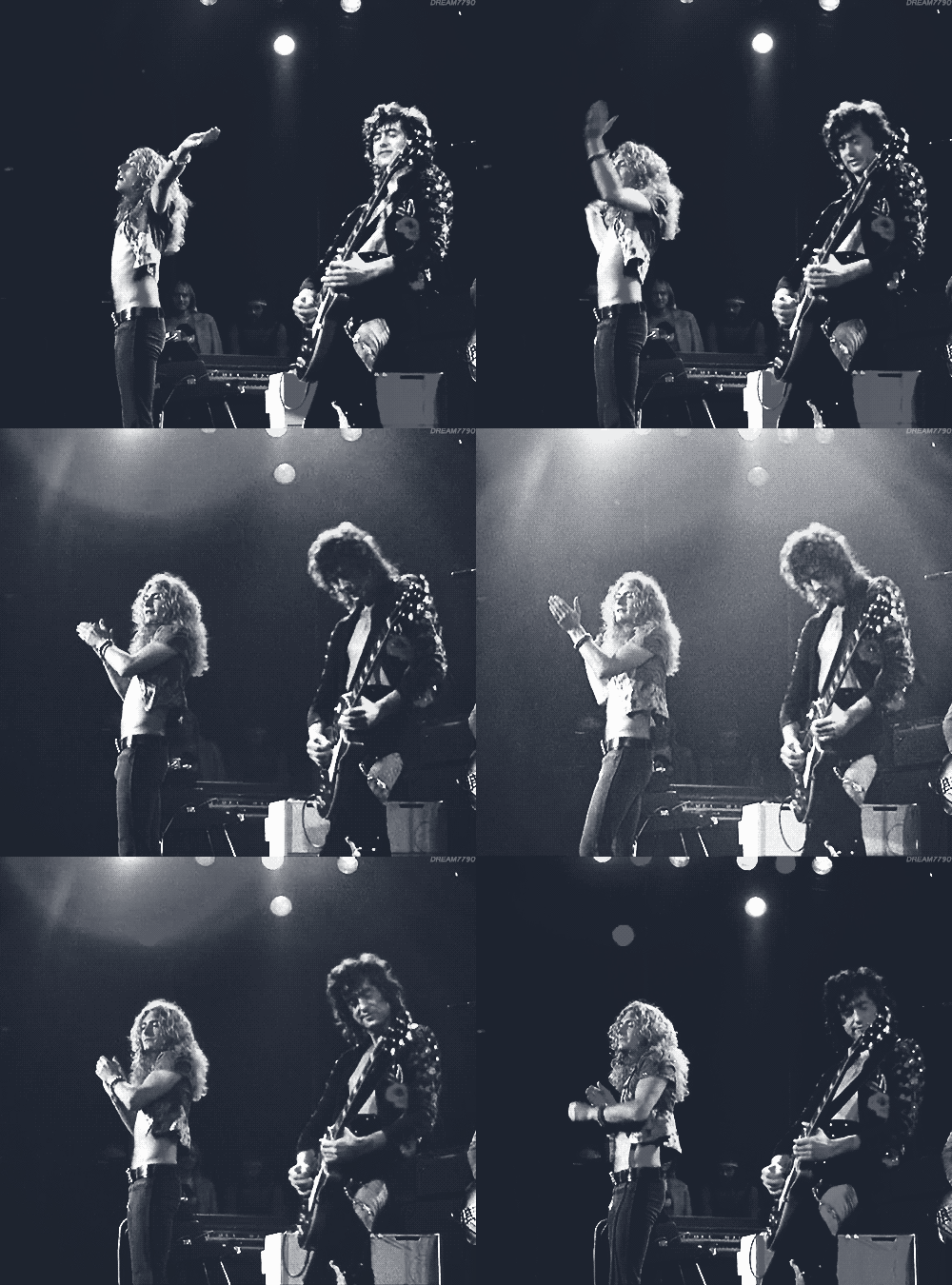
The Destroyer é uma gravação pirata da banda britânica de rock Led Zeppelin de sua performance no Richfield Coliseum, em Cleveland, Ohio em 27 de abril de 1977. A gravação da mesa de som venho do primeiro concerto de duas noites no local, que faziam parte da turnê norte-americana da banda em 1977. O álbum é intitulado simplesmente de Destroyer. As primeiras prensagens do vinil pirata incorretamente creditaram Seattle, Washington como o local do show. Uma edição limitada do conjunto de quatro LPs vinha com a legenda "gravado em 24 de junho 'LED ZEPPELIN DESTROYER' Um Caso Permanente e Exclusivo de Armazenamento do Zeppelin." O encarte agradecia a John Bonham por deixar os produtores piratas usarem a fita, e algumas músicas foram marcadas pela emenda aleatório para eles de segmentos de outras músicas. A qualidade de som excepcional durante a execução é descrita por algumas fontes como "quase perfeita". Foi a primeira, e por muitos anos a única, fita com gravação profissionalmente mixada a escapar da posse da banda.
Jamaaladeen Tacuma (born Rudy McDaniel, June 11, 1956) is an American free jazz bassist born in Hempstead, New York, perhaps best known for his albums as bandleader on the Gramavision label and for his work with Ornette Coleman during the 1970s and 1980s (particularly in Coleman's Prime Time band). Jamaaladeen's 1988 album Jukebox was nominated for a Grammy Award in 1989, but did not win. Tacuma, raised in Philadelphia, showed interest in music at a young age, performing with the organist Charles Earland in his teens. Through Earland Tacuma came to know the record producer Reggie Lucas, who introduced Jamaaladeen to Ornette Coleman in 1975 at age 19. As the electric bassist for Coleman's funky harmolodic Prime Time group, Tacuma rose to prominence quickly; another notable band member was the guitarist Bern Nix. While with Prime Time, Tacuma relied mostly on traditional technique, picking with his fingers. His later work showcased a more rhythmic, thumb-slapping funk approach.
The first three Prime Time recordings (Dancing in Your Head, Body Meta, and Of Human Feelings, all recorded in the late 1970s) feature Tacuma's work on a Rickenbacker bass, a model popular among progressive rock musicians but rarely used on jazz recordings. He switched to a Steinberger bass in the 1980s, an instrument that helped him create his readily identifiable sound. Tacuma's work with Prime Time landed him his most high-profile gig to date: an appearance with the band on Saturday Night Live on April 14, 1979, which Tacuma later cited in Musician magazine as his "best live performance ever". Besides the work with such musicians as James "Blood" Ulmer, Walt Dickerson, Chuck Hammer, and David Murray, he collaborated with the upcoming artists of the New York Downtown scene like Kip Hanrahan, David Moss, Bill Laswell and Anton Fier (The Golden Palominos, 1983) that further heightened his reputation. Tacuma's first solo album, Show Stopper, came in 1983 on the Gramavision label; the album grew out of the jazz-funk style he developed in his work with Coleman. His other works as leader at Gramavision followed that formula. In the 1980s Jamaaladeen started to perform in a relatively straightforward funk/R&B setting with his group Cosmetic. He was frequently featured in music magazines thanks to his aggressive, driving playing style and his angular fashion sense. In 1981 Tacuma received the highest number of votes ever for an electric bassist in the "talent deserving wider recognition" category of the Down Beat magazine critics poll. Since the early 1990s, he has remained active but has maintained a lower profile. He has made numerous solo and collaborative recordings, including perhaps most notably several CDs of duets with saxophonist Wolfgang Puschnig. AllMusic cited Mirakle, a recording that features Tacuma, drummer Grant Calvin Weston, and guitarist Derek Bailey as one of the "most important recordings of year 2000." In 2006, he returned to the jazz spotlight with an appearance on the World Saxophone Quartet's Political Blues. In 2007, he joined with Weston and guitarist Vernon Reid (known for his work in Living Colour and with Ronald Shannon Jackson) to form the power trio Free Form Funky Freqs. He has also recorded two albums with Basso Nouveau, a group that features multiple bassists playing together on a variety of instruments, including electric bass, upright bass and acoustic bass guitar, and that also includes bassist Gerald Veasley. In 2011, Tacuma was selected for a Pew Fellowship in the Arts.